Investigations by the US Department of Health and Human Services Office of Inspector General show that 17 percent of long-stay nursing home residents receive antipsychotics.
Why?
How can you prescribe drugs for schizophrenia to patients who don’t have it?
She wasn’t a danger to herself or others. Yet she was one of about 17 percent of long-stay nursing home residents prescribed antipsychotics. The diagnosis used to justify it—“schizophrenia”—is, according to two new reports from the US Department of Health and Human Services Office of Inspector General, applied without symptoms to one-third of patients.
Are elderly patients really a threat?
Or is something else going on?
Well, for one thing, antipsychotic drugs are a quick way to subdue a patient. In other words, it’s a labor-saving procedure for the nursing home personnel. There is a serious risk, however—for the patients, not the staff. Dementia patients on antipsychotic drugs can become drowsy and confused, unsteady on their feet and more prone to falls. They can suffer cardiovascular and cerebrovascular events, as well as permanent lung damage. And as FDA black box warnings make clear, antipsychotics can even cause death.
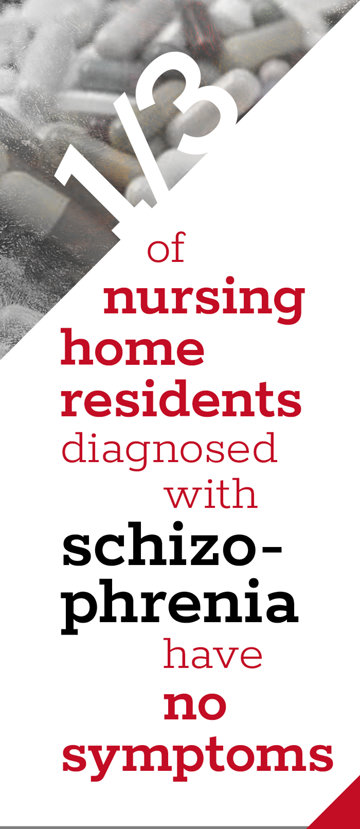
How do they get away with it? How can you prescribe drugs for schizophrenia to patients who don’t have it? Simple. Just diagnose everyone you’d like to drug with a “schizophrenia” label.
That should solve it.
The practice has the additional benefit (to the nursing homes) of artificially inflating their public performance scores. Medicare has a quality-of-care rating system for nursing homes. Your score suffers if your facility has patients falling or going to the ER, or if too many of your patients are frivolously prescribed antipsychotics.
If, however, you write “SCHIZOPHRENIC” on a patient’s record, that excludes that individual from the percentage (because, obviously, as a “schizophrenic,” he had to be prescribed the drug), which in turn prevents a high drugging rate that could damage the nursing home’s performance metrics.
One nursing home, for example, saw its reported percentage of residents prescribed antipsychotics drop from more than 80 percent to 5 percent in just a few years. This decrease corresponded with the facility systematically adding “schizophrenia” diagnoses to residents’ records, thereby masking the true rate of antipsychotic use while winning the nursing home a beautiful quality-of-care score.
Maybe it’s all a misunderstanding. No one would deliberately put elderly patients in harm’s way for ratings.
Or would they?